
Polymar / ASM Industries — custom plastic injection molding and thermoplastic solutions, ISO 9001:2015 certified, serving demanding markets for 40 years from Leola, Pennsylvania.
American manufacturers are rethinking where and how their parts get made, and custom injection molders are among the biggest beneficiaries. Two forces are converging in 2026. The first is reshoring: the Reshoring Initiative reports that 244,000 U.S. manufacturing jobs were announced in 2024 through reshoring and foreign direct investment, part of more than 2 million such jobs announced since 2010 as companies pull production back toward American customers. The second is a quieter, decades-long shift from metal to engineered plastics. Together, they are reshaping demand for custom molded components across nearly every industry — and doing so at a moment when domestic molders are unusually well positioned to capture it.
Reshoring Is Bringing Parts Back Onshore
The reshoring wave is not evenly distributed; it concentrates in exactly the industries that rely on precision molded parts. The Reshoring Initiative found that computer and electronics, electrical equipment, and transportation equipment led job announcements, with high- and medium-high-tech sectors accounting for roughly 88% of 2024’s total. Tariffs have become a leading motivator, cited in dramatically more cases than a year earlier, as companies move to insulate themselves from trade and supply-chain risk. When an OEM decides to source domestically, it needs a molder who can hold tight tolerances, document every process parameter, and scale from prototype to production without a weeks-long ocean voyage in the middle. For a U.S. custom molder, that is the entire value proposition: proximity, control, and consistency that an offshore supplier simply cannot match on lead time or oversight.
Plastics Manufacturing Is Outgrowing the Rest of the Factory Floor
The plastics industry is riding this trend from a position of real strength. According to the Plastics Industry Association’s 2025 Size and Impact Report, the U.S. plastics industry generated $550.7 billion in shipments and supported more than a million jobs (1,066,500) in 2024; counting suppliers, it accounts for 1.71 million jobs and $754.5 billion in shipments. More telling for the long run: plastics manufacturing employment grew 1.3% per year from 2014 to 2024, while total manufacturing employment grew just 0.5% per year over the same period. The plastic products sector now ranks as the eighth-largest U.S. industry by output. And Pennsylvania sits among the top five states for plastics employment, placing molders in the Northeast squarely at the center of the action — close to customers, talent, and a dense industrial base.
Why Engineered Thermoplastics Keep Replacing Metal
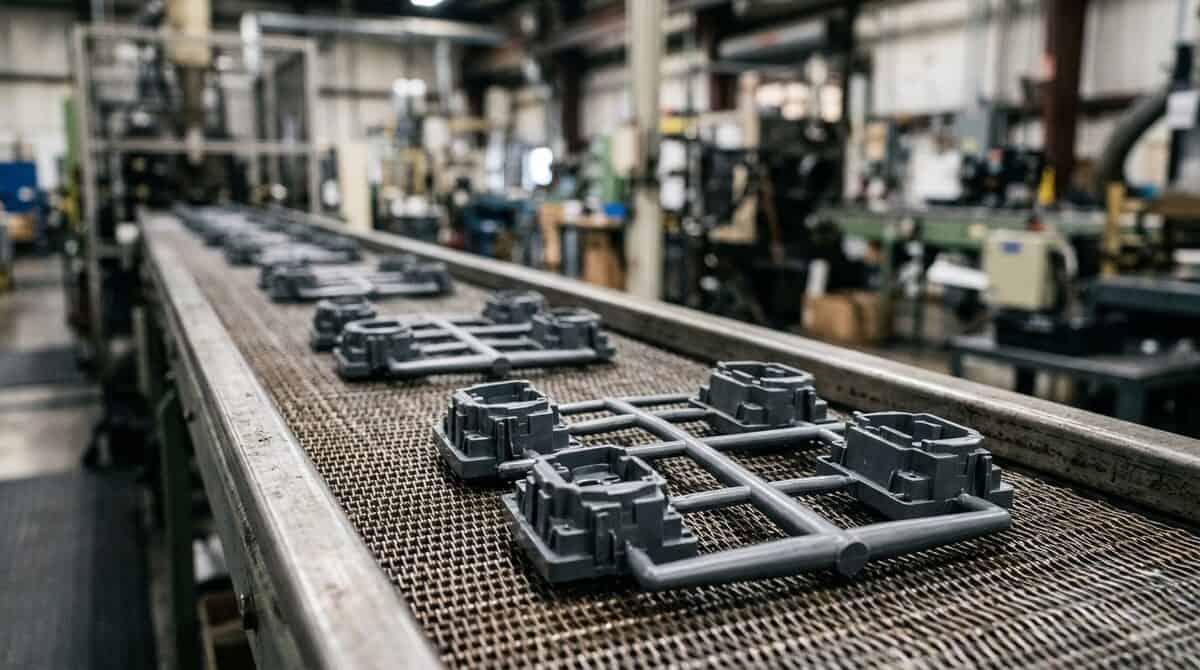
Underneath the macro numbers is a materials story. Engineering thermoplastics keep displacing metal because they are lighter, resist chemicals and corrosion better, and can be molded into complex geometries in a single shot — eliminating machining, assembly, and finishing steps that metal parts require. High-performance resins like PEEK, PPS, and PVDF now survive temperatures, pressures, and chemical exposures that once demanded metal, which is why they appear in everything from fluid-transfer pump bodies to electrical insulators to under-hood automotive components. Each metal-to-plastic conversion is a new part for a custom molder to win, and the conversions are accelerating as engineers grow more confident specifying these materials. A conversion often does more than shave weight; it consolidates several machined metal pieces into one molded part, trimming cost, assembly labor, and failure points all at once.
Every Market Has Its Own Rules
The catch — and the opportunity — is that no two markets behave alike. A medical device needs FDA-compliant materials and validated processes; an automotive component faces temperature swings and chemical exposure; an electrical enclosure must insulate and seal; a construction product has to weather years outdoors; a fluid-transfer pump body cannot be allowed to leak. That is why the shift toward custom molding rewards shops that understand the application before they cut a mold, rather than generalists who quote everything the same way. Automotive is one of the markets pulling hardest in 2026, where lightweighting is driving metal-to-plastic conversion at scale — a dynamic explored in How Automotive Lightweighting Is Driving Metal-to-Plastic Conversion in 2026. Success there, as everywhere, comes down to matching the right thermoplastic to the real operating conditions and then proving the part performs identically at unit one and unit 500,000.
What to Watch Through the Rest of 2026
The tailwinds behind custom molding are structural, not cyclical. Reshoring momentum depends partly on policy stability, and the Reshoring Initiative cautions that clearer, more permanent industrial and tariff policy would unlock a larger wave of pending commitments still on the sidelines. But the underlying drivers — supply-chain resilience, proximity to customers, and the relentless substitution of engineered plastics for metal — are not going away. Electrification is adding yet another surge of demand for molded components, examined in Electrification Is Fueling Demand for Molded Electrical Components in 2026. For OEMs deciding where to place their next program, the calculus increasingly favors a domestic molder who can move fast, document everything, and match the right thermoplastic to the application. The companies winning custom molding work in 2026 are the ones treating material selection and process control as the core of the job — and as reshoring brings more programs home and more metal parts get reimagined in plastic, the molders positioned to grow are those who already know each industry’s rules.
Polymar: Custom Molding Built Around Your Application
For 40 years, Polymar / ASM Industries has helped companies across medical, automotive, electrical, construction, industrial, and fluid-transfer markets convert ideas — and metal parts — into reliable molded thermoplastic components, backed by ISO 9001:2015 quality systems.
Our Capabilities Include:
- Custom Injection Molding Services — Fluoropolymer processing and specialty thermoplastic capabilities most shops won’t attempt, from 50 prototypes to millions of parts
- Manufacturing Capabilities — Metal inserts, assembly, secondary operations, and specialized packaging under one roof
Have a part that should be molded, not machined? Contact Polymar to discuss your industry application.
Works Cited
- “Reshoring Initiative 2024 Annual Report Including 1Q2025 Insights.” Reshoring Initiative, 9 June 2025, reshorenow.org/june-9-2025/. Accessed 22 July 2026.
- “2025 Size and Impact Report: U.S. Plastics Industry Remains Robust, Impactful, and Vital.” Plastics Industry Association, 16 Sept. 2025, www.plasticsindustry.org/newsroom/2025-size-and-impact-report-u-s-plastics-industry-remains-robust-impactful-and-vital/. Accessed 22 July 2026.