
Compounders reinforce PBT at 15% to 30% glass fiber for structural parts. The strength gain is real and immediate.
So is the cost, and it shows up as flatness.
Anisotropic Shrink Is Not a Defect
Unfilled polyester shrinks roughly the same in every direction. Add glass fiber and that stops being true.
Fibers align with the flow front during filling. Along the fiber direction, shrink drops sharply because the glass resists it. Across the fiber direction, the polymer shrinks close to its unfilled rate. One part now has two different shrink rates depending on which way you measure.
That difference is what warps the part. Not a process fault, not a bad shot, not an operator error. The material is doing what glass-filled semi-crystalline polyester does.
Both PET and PBT are strongly anisotropic in shrink, which is why both resist molding to extremely tight tolerances. Engineers who spec a flatness callout as though the material were isotropic are writing a print the resin cannot hold.
Flow Direction Is a Design Decision
Fiber orientation is set by how the resin travels through the cavity, which makes gate location a tolerance decision rather than a tooling convenience.
A single gate on a long flat part orients most fibers along one axis and bows it predictably. Two gates create a knit line where opposing flow fronts meet, and fiber orientation at that boundary runs close to random. Ribs pull flow, thickness transitions redirect it, and every one of those features writes itself into the shrink map.
None of this appears on a datasheet. Fiber reinforcement in polyester systems changes mechanical behavior substantially depending on how the reinforcement is arranged, which is the same principle operating at the scale of your gate.
Why Low-Warp Grades Keep Appearing
Resin producers now market warpage performance as a headline property, and demand pressure explains the focus.
PBT’s dimensional stability, electrical insulation, and heat resistance put it in connectors, sensor housings, and high-voltage components across electrified vehicle platforms, where parts keep getting smaller and tolerances keep tightening.
Low-warp grades help. They shift the shrink differential rather than removing it, so design still carries the load.
Fixing Warpage Before the Tool Is Cut
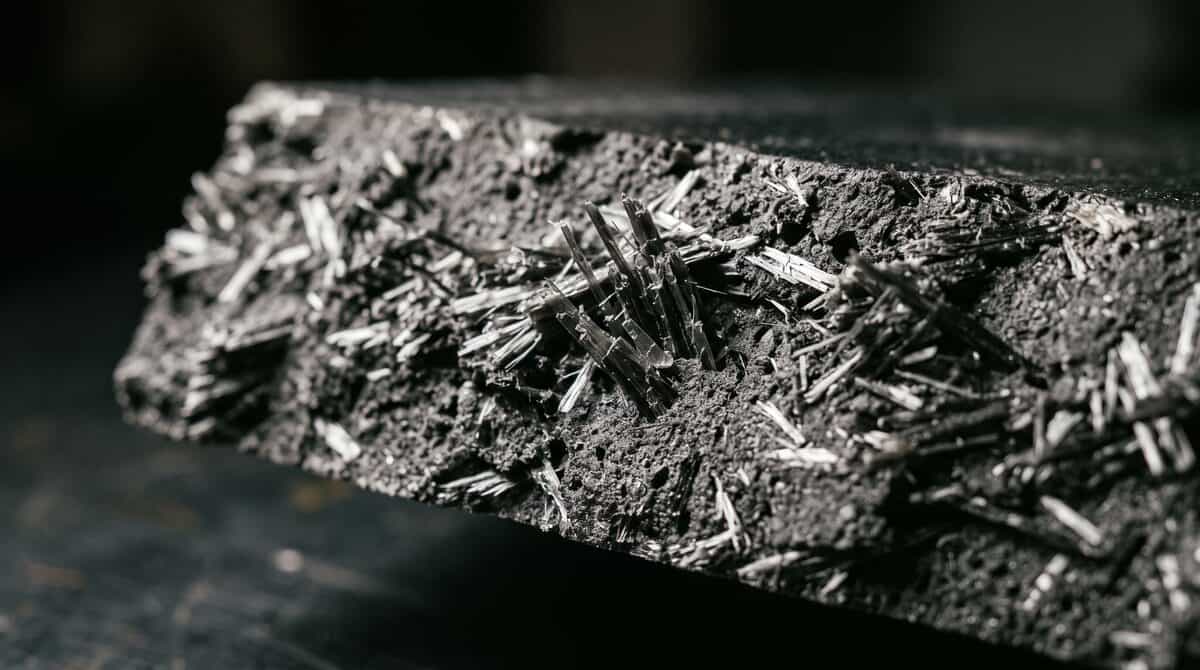
Warpage is cheapest to solve in design review and most expensive to solve in steel.
Uniform wall thickness does more than any process adjustment. Gate location should be chosen against the tolerance that matters most, not against the easiest runner layout. Ribs need consistent thickness relative to the wall, and generous radii at transitions reduce the flow disruptions that scramble orientation.
Mold temperature control matters more in polyesters than in most resins, because crystallinity develops during cooling and uneven cooling produces uneven shrink. A part cooled unevenly warps even with perfect gate design.
Where tolerance demands exceed what the geometry allows, the honest answer is to change the geometry or change the tolerance. Resin selection sits upstream of all of it, and drying practice determines whether the material behaves as the shrink model assumes.
Polymar runs PET and PBT polyester as a specialization and supports programs from design review through tooling into production. That includes telling a customer the draft is wrong before the tool gets cut.
Frequently Asked Questions About Glass-Filled PBT Warpage
01Why does my glass-filled PBT part warp after ejection?
Fiber orientation is the common cause. Glass aligns with the flow front, so the part shrinks less along the fibers than across them. That differential pulls the part out of flat as it cools. Gate location and wall uniformity usually matter more than any process adjustment.
02Does more glass fiber make warpage worse?
Generally yes, up to a point. Higher loading increases the gap between flow-direction and cross-flow shrink, which is what drives distortion. Added stiffness from that same loading resists some of the deformation. The practical answer depends on geometry, and 15% to 30% covers most structural applications.
03Can I fix warpage by changing the process instead of the tool?
Sometimes partially. Pack pressure, cooling time, and mold temperature uniformity all shift the result, and a well-tuned process recovers real flatness. Process cannot undo a gate in the wrong place or a wall that changes thickness abruptly. Design review before steel is cut remains the cheapest fix.
04Why does my part miss tolerance when the datasheet shrink value said otherwise?
Datasheet shrink comes from a molded plaque with uniform wall and simple flow. Your part has ribs, bosses, and thickness changes that redirect the flow front and scramble fiber orientation. The published number describes the material under ideal conditions rather than the geometry you actually designed.
05Will a low-warp PBT grade solve the problem on its own?
It helps and rarely finishes the job. Low-warp compounds shift the shrink differential through filler packages and fiber treatment, which narrows the gap without closing it. Pair the grade with uniform walls, considered gate placement, and even cooling to get flatness the tolerance stack can live with.
Polymar: Custom Plastic Injection Molding in Lancaster County
Polymar molds custom plastic components in Leola, Pennsylvania for the medical, automotive, electrical, and fluid transfer markets. We specialize in PET and PBT polyester and run parts from fractions of an ounce to five pounds and up.
Our Capabilities Include:
- Injection Molding Services — Design through tooling through production, for prototypes and full runs
- Insert Molding and Engineering Resins — Metal inserts, high-tolerance components, CNC closed-loop process control
Have a part to quote?
Contact Polymar with your print, your resin, and your volume.
Works Cited
- Andrzejewski, Jacek, et al. “The Use of the Overmolding Technique for the Preparation of Basalt Fiber-Based Composite: A Comparative Study of PET/PC and PBT/PC Blends.” Polymers, vol. 18, no. 1, 2025.
- “Polybutylene Terephthalate.” ScienceDirect Topics, www.sciencedirect.com/topics/pharmacology-toxicology-and-pharmaceutical-science/polybutylene-terephthalate.