
Resin selection used to be an engineering conversation. It is now partly a trade conversation, and most part designers have not caught up.
On July 24, 2026, new Section 301 tariffs took effect on goods from 60 economies. The Office of the U.S. Trade Representative opened those investigations on March 12, examining whether trading partners impose and enforce prohibitions on goods produced with forced labor. On June 2 the Trade Representative found the practices actionable in all 60 cases. Final action followed on July 23, with duties applying at 12:01 a.m. the next morning.
Rates run 10% or 12.5% depending on the economy. The European Union, Taiwan, Japan, Korea, and Switzerland are capped net of their most-favored-nation duty.
Buried in the exemption annexes is a detail that should change how engineers specify polyester.
Acetal and Nylon Kept Their Exemptions. Polyesters Never Got One.
USTR exempted every product it had proposed for exemption in June, setting aside non-pharmaceutical applications of certain chemicals, then added 471 more products on top of that list.
Polyacetal, polyamide, poly(lactic acid), PTFE, polyethylene, and polypropylene all sit on it.
PET and PBT do not. Neither appeared in the June proposal’s Chapter 39 carve-out, and neither was among the products added in July.
That absence matters at the specification stage. An engineer weighing a glass-filled PBT connector housing against an acetal alternative is no longer comparing only stiffness, creep, and dielectric strength. One resin family carries a duty exposure the other avoids, and the Harmonized Tariff Schedule assigns polyester resins their own statistical reporting numbers, which makes the distinction concrete rather than theoretical.
The engineering answer does not change because of a tariff schedule. What changes is that resin choice now carries a sourcing question alongside the performance question.
Where PET and PBT Actually Differ
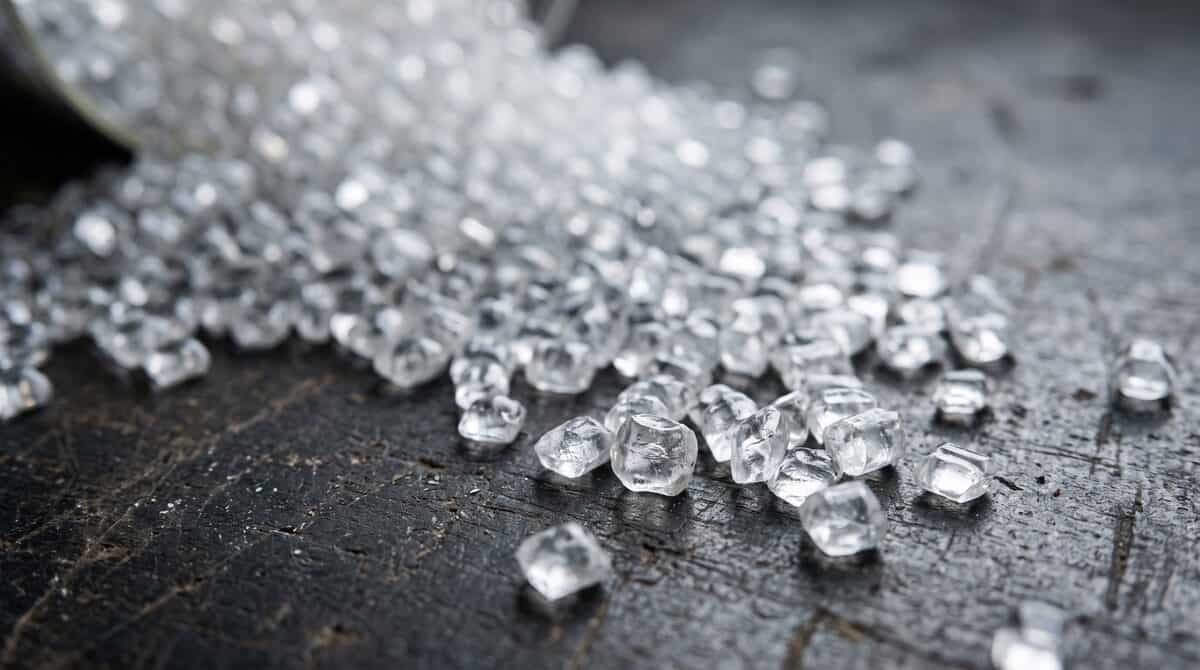
Both are semi-crystalline thermoplastic polyesters built from terephthalic acid. The difference sits in the alcohol, and that difference drives everything downstream.
PBT crystallizes fast. Fast enough that under normal processing conditions you cannot produce an amorphous PBT part, which is why PBT cycles quickly and releases cleanly. PET crystallizes slowly, so mold temperature does real work in determining what you get. Run PET cold and you get an amorphous part that never develops the properties the datasheet promised.
PET repays the extra process attention with higher stiffness, a higher melting point, and better strength at room temperature. Its melt viscosity also tends to run lower than PBT at the same reinforcement level, so thin walls fill and highly filled compounds finish better.
Both share one weakness that ends programs: they hydrolyze. Heat either polyester above its melting point with moisture present and the polymer chains break. Molecular weight drops, mechanical performance follows, and the part looks fine. Drying practice is the difference between a polyester part that performs and one that fails in the field.
Glass Fill Buys Strength and Costs You Flatness
Compounders typically reinforce polyester at 15% to 30% glass fiber for structural parts. The strength gain is substantial and the trade-off is immediate.
Glass-filled polyesters shrink anisotropically. Material shrinks differently along the fiber direction than across it, and fiber direction is set by how the resin flowed. Gate location, wall transitions, and rib placement all become tolerance decisions before a single shot runs.
Datasheet shrink values come from a molded plaque with uniform flow, and your part is not a plaque. Understanding how fiber orientation breaks a tolerance stack is what separates a program that qualifies from one that gets requoted.
What to Ask Before You Lock the Resin
Three questions are worth asking while the design is still soft.
Ask whether the grade you specified comes from a domestic compounder or arrives as an import. Ask what the drying specification is, and whether your molder measures dew point or trusts a timer. Ask whether the tolerances on the print survive anisotropic shrink, or whether the tolerance stack assumes isotropic behavior that polyesters never deliver.
The trade picture will keep moving, and the scope of covered goods and exemptions is set out in the final USTR notice. What holds steady is the engineering: polyesters reward molders who dry properly, control mold temperature, and design around fiber orientation.
Polymar molds PET and PBT polyester as a specialization rather than an occasional job. That focus shows up in drying discipline, mold temperature control, and the willingness to tell a customer their draft is wrong before the tool is cut.
Frequently Asked Questions About PET and PBT Injection Molding
01Which is better for my part, PET or PBT?
Neither wins outright. PBT crystallizes faster, cycles quicker, and releases more cleanly, which suits high-volume connectors. PET runs stiffer and stronger at room temperature with a higher melting point. Your wall thickness, tolerance, service temperature, and volume decide it. Bring the print and the application to the conversation.
02Can I run PET in a tool built for PBT?
Rarely without changes. PET needs higher melt and mold temperatures to develop crystallinity, and shrink rates differ between the two resins. Gate size and cooling layout designed around PBT often will not deliver a dimensionally sound PET part. Treat it as a tooling review, not a material swap.
03Do the Section 301 tariffs apply to molded parts or only to resin?
The action covers goods broadly by country of origin rather than by industry, with exemptions listed in the annexes. Finished molded components imported from a covered economy can carry duty alongside resin. Check your specific classification and origin against the current notice before modeling landed cost.
04What tolerance can injection molding hold in glass-filled polyester?
Tighter than most engineers expect in the flow direction, looser across it. Anisotropic shrink means a single tolerance band applied in every direction usually misses. Dimension the print against flow, review gate location early, and set the tolerance where the function needs it rather than uniformly across the part.
05Is PBT a good candidate for replacing a metal component?
Often yes, in connectors, housings, and brackets where dielectric strength, corrosion resistance, and part consolidation matter more than absolute stiffness. Glass reinforcement closes much of the mechanical gap. Wall thickness, insert placement, and assembly loads drive the answer, so bring the metal print and the load case together.
Polymar: Custom Plastic Injection Molding in Lancaster County
Polymar molds custom plastic components in Leola, Pennsylvania for the medical, automotive, electrical, and fluid transfer markets. We specialize in PET and PBT polyester and run parts from fractions of an ounce to five pounds and up.
Our Capabilities Include:
- Insert Molding and Engineering Resins — Metal inserts, high-tolerance components, CNC closed-loop process control
- Injection Molding Services — Design through tooling through production, for prototypes and full runs
Have a part to quote?
Contact Polymar with your print, your resin, and your volume.
Works Cited
- Office of the United States Trade Representative. “Notice of Actions in Section 301 Investigations of Acts, Policies, and Practices of Various Economies Related to the Failure of Each Economy to Impose and Effectively Enforce a Prohibition on the Importation of Goods Produced with Forced Labor.” Federal Register, 28 July 2026.
- United States International Trade Commission. “Harmonized Tariff Schedule of the United States.” USITC, hts.usitc.gov/.