
The worst molding defect is the one you cannot see.
A glass-filled PBT connector housing comes off the press dimensionally correct. It passes visual inspection. It ships. Eight months into service, in a humid under-hood environment, it cracks at the boss. Nothing in the process log looks wrong.
The resin was wet when it hit the barrel.
What Hydrolysis Actually Does
Polyesters are condensation polymers, and condensation reactions run backward when water is present.
Heat PET or PBT above its melting point with excess moisture in the pellet and the polymer chains break. Molecular weight drops. Mechanical performance drops with it. The material still fills the cavity, still holds the dimension, still looks like the part you designed.
What it no longer has is the chain length that gave it toughness. Polyesters pick up moisture from ambient air, so an open gaylord in a Lancaster County plant in August is a problem long before the material reaches the hopper.
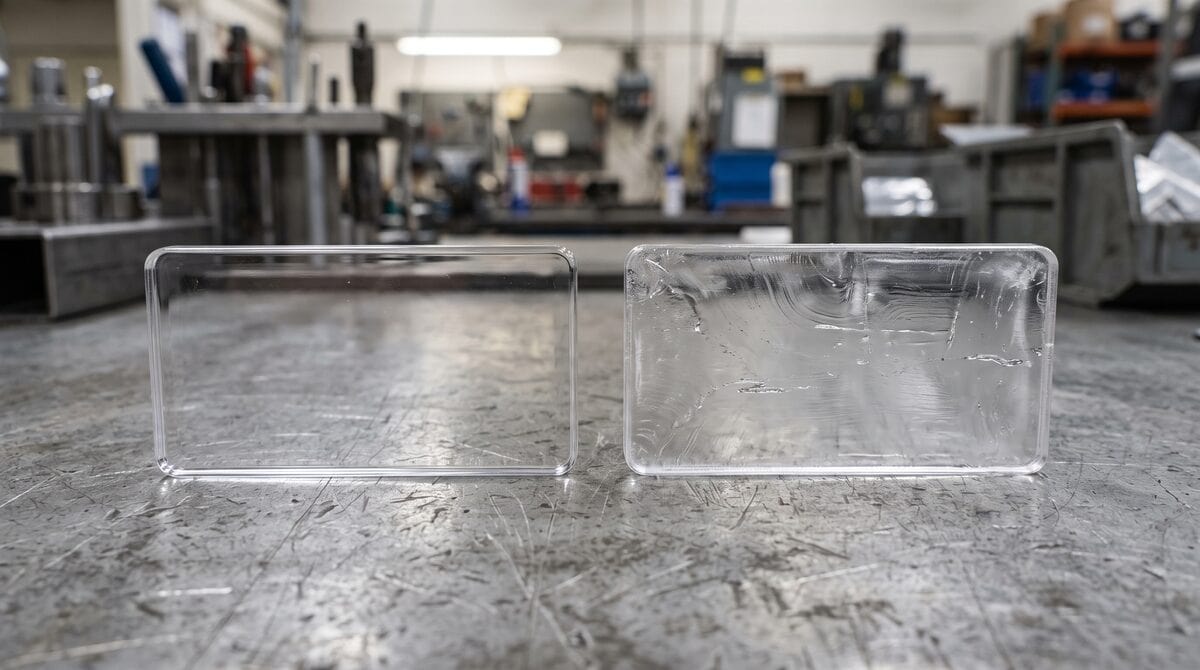
Splay is the visible warning. Silver streaking radiating from the gate means moisture flashed to steam in the barrel. Plenty of wet material never splays at all, which is why splay is a symptom rather than a screen.
Why Timers Are Not a Drying Specification
Most drying failures come from treating drying as a duration instead of a condition.
A four-hour timer tells you how long the dryer ran. It says nothing about dew point at the hopper inlet, whether the desiccant bed regenerated, whether return air is being pulled from a humid plant floor, or whether the material sat in an open container for a shift before loading.
Polyester drying depends on three variables together: temperature, residence time, and the dryness of the air moving through the bed. Miss any one and the other two do not compensate.
The Grade You Specified Changes the Answer
Drying requirements are not uniform across the polyester family.
PET runs at a higher melting point than PBT and demands more from the dryer. Glass-filled grades behave differently from unfilled. Flame-retardant compounds carry additives with their own moisture sensitivity. Regrind, which has already seen one heat history, is not equivalent to virgin material at the same dryer setting.
The low water absorption that makes polyesters dimensionally stable in service is a property of the finished part, not the pellet. Those are two different conversations, and confusing them is how a specification ends up silent on drying entirely.
If your print does not state a drying specification with a dew point requirement, your molder is choosing one for you.
Questions Worth Asking Your Molder
Ask what dew point they hold at the hopper inlet and how they measure it. Ask whether dryers are alarmed and logged, or checked by a technician on rounds. Ask what happens to material that sits in a hopper through an unplanned downtime.
Ask how they handle regrind, and whether regrind runs at the same drying parameters as virgin material.
These questions separate a molder who dries material from one who runs a timer. The answers also predict how a polyester part behaves once fiber orientation enters the picture, because a hydrolyzed part warps differently than a sound one.
Polymar specializes in PET and PBT polyester, which makes drying a daily discipline rather than an occasional consideration. CNC closed-loop process controls hold parameters within the validated window across the run. Resin choice and processing behavior are linked from the first specification decision.
Frequently Asked Questions About Polyester Resin Drying
01How long do you dry PBT before molding?
Time alone is not the specification. Most PBT grades call for two to four hours in a desiccant dryer, though the controlling variable is dew point at the hopper inlet paired with the resin temperature. Check the supplier data sheet for your specific grade and confirm the dryer holds condition.
02Why is my PBT part brittle even though it molded fine?
Hydrolysis is the usual suspect. Moisture in the pellet breaks polymer chains at melt temperature, cutting molecular weight without changing how the part looks or measures. Toughness drops while dimensions hold. Review drying records, dryer dew point, and material handling before you start adjusting process parameters.
03What does splay mean on a molded part?
Splay is silver or cloudy streaking that radiates from the gate along the flow path. In polyesters it usually signals moisture flashing to steam inside the barrel. Splay confirms a drying problem when present, though plenty of wet material molds without it, so treat splay as a symptom.
04Can regrind run at the same dryer settings as virgin material?
Treat it separately. Regrind has already been through one heat history, so its molecular weight starts lower and it picks up moisture across more surface area. Blending ratio, drying parameters, and traceability all need a documented policy rather than a shop-floor decision made shift by shift.
05Should the drying specification appear on my print?
Putting it on the print removes ambiguity. State the dew point requirement, resin temperature, and maximum residence time rather than a bare drying duration. A print silent on drying leaves the choice to whoever runs the job, which makes results harder to compare across molders or across quotes.
Polymar: Custom Plastic Injection Molding in Lancaster County
Polymar molds custom plastic components in Leola, Pennsylvania for the medical, automotive, electrical, and fluid transfer markets. We specialize in PET and PBT polyester and run parts from fractions of an ounce to five pounds and up.
Our Capabilities Include:
- Quality Assurance and Process Control — Documented parameters, CNC closed-loop control, process validation practice
- Markets We Serve — Medical, automotive, electrical, fluid transfer, construction, aerospace
Have a part to quote?
Contact Polymar with your print, your resin, and your volume.
Works Cited
- “PE Polyesters, Thermoplastic (PETP, PBT, PET).” UL Prospector, www.ulprospector.com/knowledge/12125/pe-polyesters-thermoplastic-petp-pbt-pet/.
- “Polyesters (Thermoplastic) PETP, PBT, PET.” British Plastics Federation, www.bpf.co.uk/plastipedia/polymers/polyesters.aspx.