
A molded part that needs a metal insert, an ultrasonic weld, a hot-stamped mark, and a bar-coded carton can touch four companies before it reaches your dock. Each handoff transfers responsibility. Responsibility is what goes missing when the part fails.
The problem has federal attention. In August 2025, the NIST Manufacturing Extension Partnership and the Small Business Administration published a handbook on bringing supply chains back home, aimed at small and medium-sized manufacturers and the original equipment manufacturers who buy from them.
Supply chain fragility is measured now rather than assumed. The question for a buyer is narrower: how many companies does your part pass through, and what happens at each seam.
Where Multi-Vendor Programs Actually Break
The failure is rarely the molding. It is the seam between operations.
A molder ships to a secondary house that presses the insert. Fit is marginal. The secondary house adjusts its press setup rather than calling the molder, because calling means admitting a problem and losing a day. Six months later parts begin failing at the boss, and nobody can say which process drifted.
Traceability breaks the same way. Lot records live in three systems that were never designed to talk to each other. When a quality engineer asks which resin lot went into which shipment, the answer takes a week.
Schedule is the third casualty. Each vendor quotes lead time against its own queue, and those queues do not coordinate. Your program absorbs the stacking.
What Belongs Under One Roof
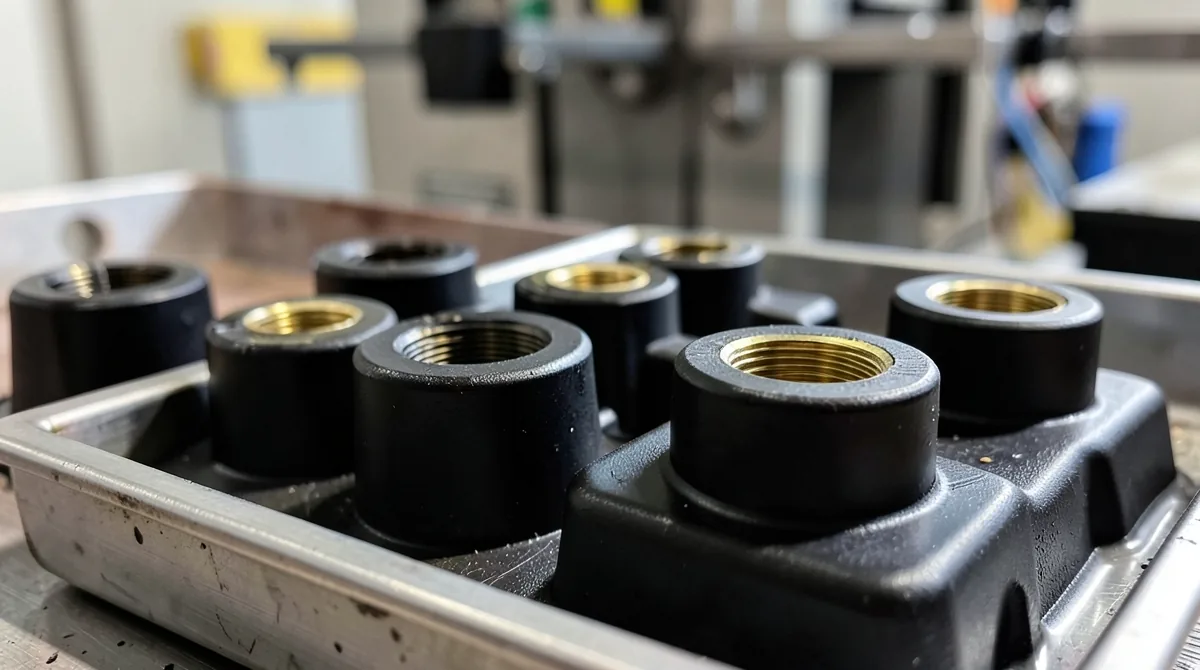
Not every operation needs to be in house. The ones worth consolidating share a trait: they change the part after molding in ways that interact with how it was molded.
Metal inserts. Insert placement interacts with shrink, knit lines, and boss geometry. Splitting molding from insert work splits the diagnosis when a boss cracks.
Ultrasonic welding and hot stamping. Both apply energy to a molded surface. Weld quality depends on joint design and material condition, which trace back to the tool and the process.
Assembly on cycle. Inspecting and assembling at the press catches drift in the same shift it occurs, rather than three weeks later at a different address.
Labeling and packaging. Bar-coded cartons and customer-specified supply chain arrangements are where traceability either holds or dissolves.
The Questions Worth Asking a Molder
Ask what share of the work on your part happens at their address. Ask who owns the quality record when an operation goes outside. Ask whether they are EDI capable, and on which transaction types.
Ask what happens when a secondary operation reveals a molding problem, specifically who makes that call and how quickly. More than half of a manufacturer’s total spending happens in the supply chain on average, which is why MEP centers help companies map it, identify sources of risk, and build risk management plans. The same exercise works at the level of a single part number.
Molders running specialty materials such as PVC, CPVC, and fluoropolymers tend to keep more operations in house, because outside vendors often decline those materials. The decision about where the metal enters the part usually determines how many vendors a program needs.
Polymar performs sonic welding, hot stamping, and assembly on cycle in Leola, and bar-codes carton labels to customer specification. That matters less as a capability list than as an answer to the traceability question.
Frequently Asked Questions About Single-Source Injection Molding
01What does under one roof actually mean at a molder?
It means the operations after molding happen at the same address rather than at a subcontractor. Insert placement, ultrasonic welding, hot stamping, assembly, inspection, labeling, and packaging all stay in one building. Ask for the specific list, because the phrase covers very different arrangements at different shops.
02Who owns the quality record when a molder subcontracts an operation?
That depends on the agreement, and the answer is worth getting in writing before the program starts. Subcontracted work often generates records in a separate system under separate control. Ask how lot traceability passes across that boundary and who responds when a customer audit follows the trail.
03Does single sourcing cost more than using separate vendors?
Piece price sometimes looks higher. Total cost of ownership usually runs lower once you count freight between vendors, duplicate inspection, stacked lead times, higher inventory carrying costs, and the overhead of managing distant suppliers. Compare landed cost across the full routing rather than quote by quote.
04What is assembly on cycle?
Assembly on cycle means components are inspected and assembled at the press while parts are still running, rather than batched and handled later. Drift gets caught in the shift it occurs. The practice also removes a material handling step and a separate fixture setup from the routing.
05Can a molder handle my packaging and labeling requirements?
Many can, and the details matter for traceability. Ask whether carton labels can be bar-coded with customer-specified information, whether custom supply chain arrangements are supported, and which EDI transaction types are available. Polymar supports purchase orders, functional acknowledgements, and advance ship notices.
Polymar: Custom Plastic Injection Molding in Lancaster County
Polymar molds custom plastic components in Leola, Pennsylvania for the medical, automotive, electrical, and fluid transfer markets. We specialize in PET and PBT polyester and run parts from fractions of an ounce to five pounds and up.
Our Capabilities Include:
- Injection Molding Services — Tooling programs, sonic welding, hot stamping, assembly on cycle, EDI
- Insert Molding and Engineering Resins — Metal inserts, high-tolerance components, CNC closed-loop process control
Have a part to quote?
Contact Polymar with your print, your resin, and your volume.
Works Cited
- National Institute of Standards and Technology and U.S. Small Business Administration. “Make Onshoring Great Again Handbook.” NIST Manufacturing Extension Partnership, Aug. 2025.
- National Institute of Standards and Technology. “Supply Chain Management.” NIST Manufacturing Extension Partnership.