
Most molders quote in commodity resins. Ask about CPVC and the conversation gets shorter. Ask about fluoropolymers and it often ends.
The reluctance is rational. These materials attack tooling, call for corrosion-resistant screws and barrels, run in narrow process windows, and carry handling requirements that commodity polypropylene does not. A shop set up for filled nylon cannot simply load a fluoropolymer and press start.
Why These Materials Exist in the First Place
Engineers specify them when nothing else survives the environment.
Fluoropolymers contribute fire resistance along with oil, stain, grease, and water repellency, which is why they appear across aerospace, automotive, building and construction, chemical processing, electronics, semiconductor, and textile applications. PVC and CPVC bring chemical resistance and flame performance at a cost commodity resins cannot match once the service environment turns aggressive.
Fluid transfer is where this shows up most often. A pump body carrying an aggressive medium has a short list of candidate materials, and that list is expensive to get wrong.
The Processing Constraints Are Real
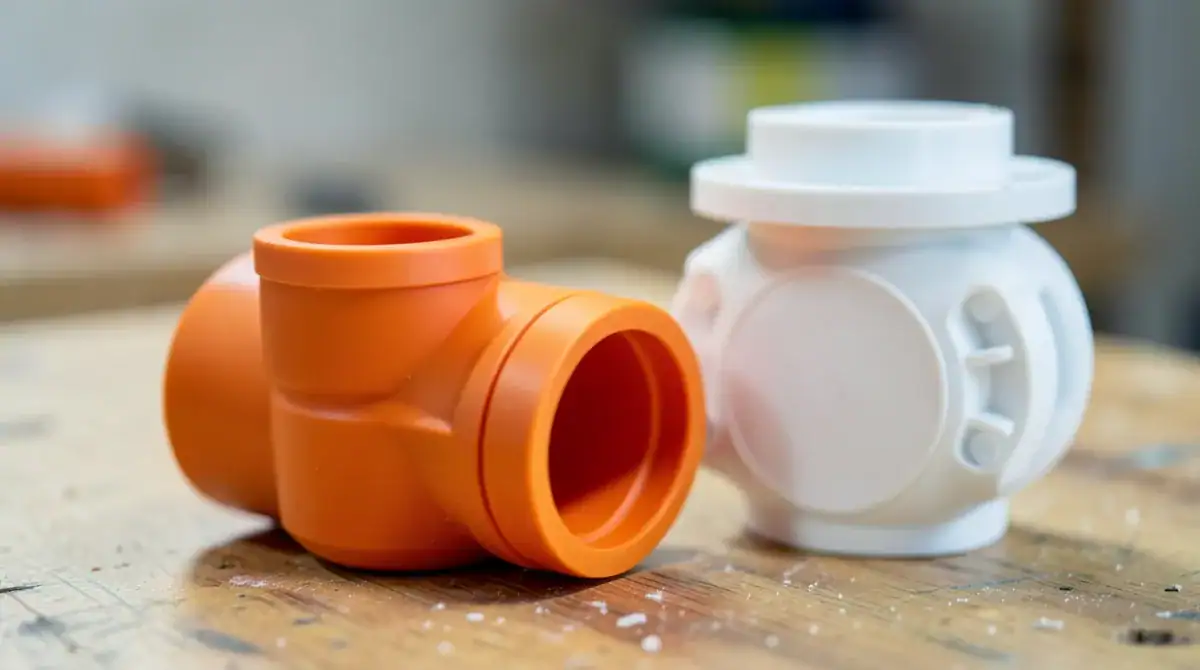
PVC and CPVC degrade thermally and release corrosive byproducts as they do. That drives corrosion-resistant tooling and screw materials, tight melt temperature control, and purge discipline at shutdown. Residence time matters more than it does in almost any other resin family.
Fluoropolymers add abrasion and higher processing temperatures. Melt-processable grades behave very differently from PTFE, which is not conventionally injection molded at all. Naming the specific grade matters more here than in any other material conversation.
Flame-retardant and lubricated grades occupy adjacent territory. Both carry additive packages with their own moisture behavior, and both affect how many vendors a program needs to touch once secondary work enters the routing.
Regulatory Pressure Is Now Part of the Specification
Fluoropolymer material selection carries a compliance dimension that did not exist a decade ago.
Under Section 8(a)(7) of the Toxic Substances Control Act, entities that manufactured or imported PFAS or PFAS-containing articles since 2011 face a one-time reporting obligation. EPA moved the start of the submission period to January 31, 2027, or 60 days after a forthcoming final rule on the substantive requirements, whichever comes first.
That timeline is worth tracking if fluoropolymer components sit in your bill of materials.
This article is general industry information and is not regulatory or compliance advice. Consult the current published standard and a qualified professional for your specific application.
What to Bring to a Specialty Molding Quote
Name the exact grade rather than the family. Describe the service environment: chemical exposure, temperature, pressure, and duty cycle. State whether a flame rating or chemical certification applies downstream.
Say what the part has to do mechanically, because a specialty material sometimes solves a problem that geometry could solve more cheaply.
Polymar’s material experience runs from commodity resins through reinforced, lubricated, and flame-retardant grades to the exotics, PVC, CPVC, and fluoropolymers. Where a program needs metal and polymer combined in one part, that work happens in Leola as well.
Frequently Asked Questions About Specialty Thermoplastic Molding
01Can fluoropolymers be injection molded?
Melt-processable fluoropolymer grades can be injection molded with suitable equipment. PTFE is the exception and is not conventionally injection molded, since it does not flow as a normal thermoplastic melt. The distinction matters at quoting, so name the specific grade rather than the material family.
02Why do most molders avoid PVC and CPVC?
Both degrade thermally and release corrosive byproducts as they do. Running them calls for corrosion-resistant screws, barrels, and tooling, tight melt temperature control, and disciplined purging at shutdown. Shops without that equipment risk damaging machines, so many decline the work rather than retool for it.
03What is the difference between PTFE and melt-processable fluoropolymers?
PTFE has extremely high melt viscosity and is typically compression molded or ram extruded rather than injection molded. Melt-processable grades were developed to flow under conventional processing while retaining much of the chemical and thermal performance. Property trade-offs exist, so match the grade to the service condition.
04Do PFAS regulations affect my fluoropolymer parts?
They can, depending on your role in the supply chain. TSCA Section 8(a)(7) places a one-time reporting obligation on entities that manufactured or imported PFAS or PFAS-containing articles since 2011. Check current rule text and scope for your situation rather than relying on summaries.
05What should I send a molder when quoting a specialty resin part?
Send the print, the exact resin grade, and a description of the service environment covering chemical exposure, temperature, pressure, and duty cycle. Note any downstream flame rating or certification requirement. Include expected annual volume, since specialty tooling economics shift sharply with quantity.
Polymar: Custom Plastic Injection Molding in Lancaster County
Polymar molds custom plastic components in Leola, Pennsylvania for the medical, automotive, electrical, and fluid transfer markets. We specialize in PET and PBT polyester and run parts from fractions of an ounce to five pounds and up.
Our Capabilities Include:
- Markets We Serve — Automotive, medical, electrical, fluid transfer, construction, aerospace
- Insert Molding and Engineering Resins — Metal inserts, high-tolerance components, CNC closed-loop process control
Have a part to quote?
Contact Polymar with your print, your resin, and your volume.
Works Cited
- U.S. Environmental Protection Agency. “Risk Management for Per- and Polyfluoroalkyl Substances (PFAS) under TSCA.” EPA.
- U.S. Environmental Protection Agency. “Modification to the Start of the Submission Period for PFAS Reporting and Recordkeeping Under TSCA 8(a)(7).” Federal Register, 13 Apr. 2026.